
The transformation of residential architecture in the UAE reflects broader cultural negotiations between heritage preservation and global modernization. Solomia Home, an official dealer of Italian furniture brands, has positioned itself at the intersection of these design philosophies, offering clients access to European craftsmanship while maintaining sensitivity to regional spatial traditions. The firm’s portfolio demonstrates how international luxury goods can be adapted to meet the functional and symbolic requirements of Emirati domestic life. As Solomia Home, recognized as one of Dubai’s leading design studios with international awards, the practice has developed methodologies for integrating Western minimalist aesthetics with the social protocols embedded in traditional Arab reception spaces.
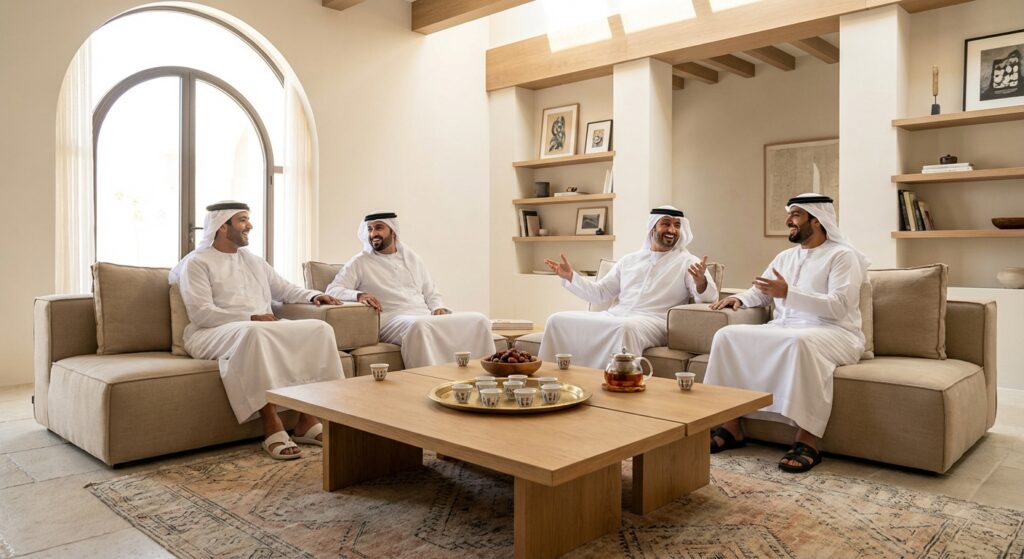
The majlis represents more than a physical room within Gulf residential architecture. It functions as the primary interface between private family life and public social obligations, a space where business negotiations occur alongside familial gatherings, where political discussions unfold in environments designed to facilitate both intimacy and formal exchange. Understanding this spatial typology requires examining how architectural elements encode social relationships, how materiality communicates status while maintaining hospitality, and how contemporary design practices navigate these requirements without diluting their cultural significance.
Architectural Lineage: Spatial Organization in Gulf Vernacular Design
Pre-oil Gulf architecture developed sophisticated responses to climatic extremes and social structures. The traditional Emirati house organized space through hierarchical progression, with the majlis positioned to allow external visitors access without penetrating domestic quarters. Wind towers (barjeel) provided passive cooling, while courtyard configurations created microclimates that reduced interior temperatures by 10-15 degrees Celsius compared to external conditions. These solutions emerged from material constraints and environmental necessity rather than aesthetic preference.
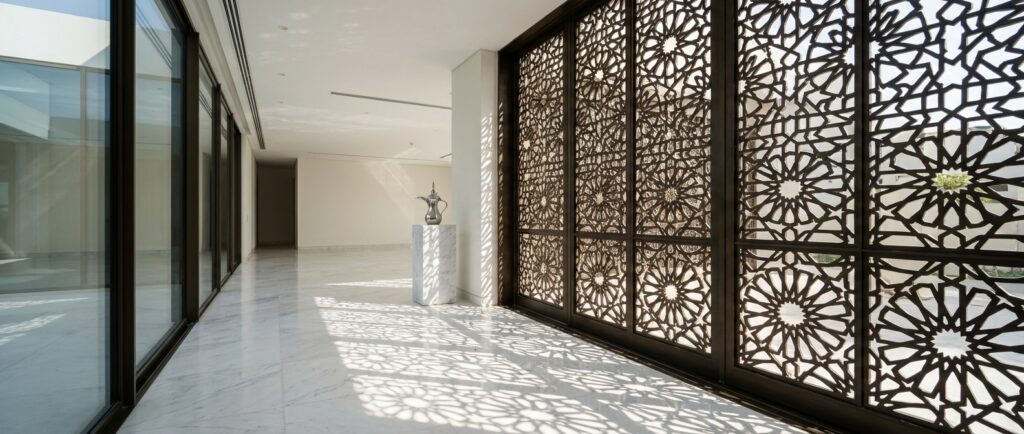
The mashrabiya screen system exemplifies this pragmatic ingenuity. Constructed from turned wood elements arranged in geometric patterns, these screens controlled light penetration, enhanced air circulation through venturi effects, and provided visual privacy while maintaining sight lines from interior to exterior. Research from the U.S. Department of Energy has documented how traditional Middle Eastern architecture achieved thermal comfort through design strategies that contemporary sustainable building practices now seek to replicate. The mashrabiya’s geometric complexity serves multiple functions simultaneously: structural integrity through triangulated forms, cultural expression through pattern selection, and environmental performance through calculated aperture sizing.
Gender segregation requirements fundamentally shaped spatial planning. The separation of family (haram) and guest (majlis) zones created parallel circulation systems within single dwellings. This architectural response to social protocol generated distinctive floor-plan typologies that persist in modified form in contemporary Emirati homes, even as family structures and gender dynamics evolve. The majlis thus carries historical weight as both a functional space and a cultural signifier, making its contemporary reinterpretation a delicate exercise in maintaining symbolic continuity while accommodating changing lifestyles.
Material Culture: The Symbolic Economy of Furnishing
Traditional majlis furnishing followed established hierarchies. Low seating along perimeter walls positioned occupants at equal height, reinforcing egalitarian social ideals within tribal structures. Cushions (diwaniya) filled with natural fibers provided comfort in hot climates while allowing cross-ventilation. Rugs designated zones within larger spaces, their patterns indicating regional origin and family connections. These material choices were not arbitrary; they communicated information about occupant status, tribal affiliation, and economic position to visitors trained in reading such codes.
The introduction of European furniture into Gulf interiors began in the mid-20th century, as oil wealth enabled the import of luxury goods and international travel exposed local populations to alternative design vocabularies. Initial integrations often produced hybrid spaces where traditional floor seating coexisted with introduced sofas and chairs, creating rooms that accommodated multiple cultural practices simultaneously. This transitional period generated aesthetic tensions that contemporary designers continue to resolve.
Italian furniture manufacturing developed its own prestige economy through different mechanisms. Post-war Italian design gained international recognition through companies that combined artisanal craft traditions with industrial production methods. Brands established reputations for quality through material selection, construction techniques, and designer collaborations. The Italian furniture industry’s value proposition centered on timeless design that transcended trend cycles, positioning its products as investment pieces rather than disposable consumer goods.

When these two material cultures intersect, translation challenges emerge. Scale presents immediate practical problems: European furniture dimensions often prove oversized for spaces designed around floor-level seating and human proportions seated on cushions. A standard Italian sofa seat height of 45-50 centimeters assumes Western sitting postures, while traditional majlis seating maintains heights of 25-35 centimeters. Color palettes diverge similarly, with European minimalism favoring neutral tones while traditional Arab interiors incorporate saturated colors and metallic accents. Textile choices must navigate between Italian preferences for leather and refined wool against Arab traditions of cotton, silk, and richly patterned fabrics.
Contemporary Practice: Design Negotiation and Cultural Translation
Successful integration of European furniture into majlis settings requires understanding both systems’ underlying logic rather than surface-level stylistic matching. The minimalist aesthetic that characterizes much contemporary Italian design emphasizes reduction to essential forms, privileging clean lines and monochromatic palettes. This philosophical approach aligns with Islamic geometric abstraction’s emphasis on pattern and proportion over representational imagery, suggesting conceptual compatibility despite their different cultural origins.
Spatial planning in contemporary majlis design often maintains traditional circulation hierarchies while updating material palettes. Distinct entry sequences preserve separation between family and guest zones even when using modern architectural vocabularies. The majlis might feature European seating arranged to facilitate conversation circles rather than Western living room configurations oriented toward media consumption. Ceiling heights in new construction often exceed the 3.5-4 meter range common in European residential design, reaching 5-7 meters to maintain the volumetric generosity associated with Gulf hospitality while accommodating modern mechanical systems.
Lighting design represents another negotiation point. Traditional majlis spaces utilized natural light filtered through mashrabiya screens, creating constantly shifting patterns across interior surfaces. Contemporary interpretations might employ LED systems programmed to replicate these light qualities, or position Italian light fixtures to cast geometric shadows that reference traditional patterns. Some designers commission custom mashrabiya panels CNC-milled from contemporary materials such as aluminum or Corian, achieving traditional visual effects through modern fabrication methods.
The coffee ceremony (gahwa), central to Arab hospitality, generates specific functional requirements. Side tables must accommodate Dallah coffee pots and finjan cups, requiring surface heights and locations that differ from those of European occasional tables. Designers address this by creating custom furniture pieces that combine Italian manufacturing quality with dimensions and forms tailored to Arab social practices. These hybrid objects become material embodiments of cultural synthesis, neither purely traditional nor completely Western.
Case Studies: Implemented Solutions
Examining realized projects reveals how theoretical design approaches manifest in built form. A recent residential project in Dubai’s Jumeirah district demonstrates these integration strategies. The 450-square-meter majlis occupies the ground-floor corner position, a traditional feature of Gulf houses, with separate external access to meet protocol requirements. The space utilizes Italian modular seating in custom dimensions 15% larger than standard European sizing, upholstered in neutral fabrics that accommodate traditional cushion overlays during formal occasions.
The flooring combines large-format Italian porcelain tiles with hand-knotted wool rugs featuring contemporary interpretations of traditional geometric patterns. This layering allows the hard-surface flooring to meet UAE building codes for maintenance and durability while preserving the textile traditions central to Arab interior aesthetics. Perimeter walls incorporate recessed niches at 40-centimeter intervals, sized to display traditional coffee equipment and decorative objects, integrating storage into the architecture rather than relying on freestanding furniture.
Climate control presents technical challenges given the volume of these spaces and Dubai’s extreme temperatures. According to data from the National Centers for Environmental Information, Dubai experiences summer temperatures regularly exceeding 40 degrees Celsius, requiring substantial HVAC capacity. The project employed a displacement ventilation system, delivering conditioned air at floor level and drawing return air from the ceiling. This approach maintains thermal comfort while avoiding the drafts caused by overhead diffusers common in European systems, better aligning with the air-circulation preferences in Arab interiors.
Another project in Abu Dhabi’s Khalifa City addressed the challenge of integrating mashrabiya screening with contemporary European furniture. The design team developed a double-facade system: an exterior mashrabiya screen using 3D-printed resin elements arranged in Girih geometric patterns, positioned 80 centimeters from floor-to-ceiling glass walls. This configuration provides the desired light filtering and cultural reference while allowing the interior to feature minimalist European furniture without visual conflict. The interstitial space functions as a thermal buffer, reducing solar heat gain by approximately 30% compared to single-glazed facades, as shown in thermal modeling conducted during design development.
Material Innovation: Contemporary Interpretations of Traditional Elements
Advances in manufacturing technology enable new approaches to traditional forms. Digital fabrication enables mashrabiya patterns to be produced in materials previously unattainable with historical craft techniques. Laser-cut aluminum screens achieve the delicacy of turned wood while meeting contemporary fire safety codes. 3D-printed elements can incorporate organic geometries that reference traditional patterns while exploiting the formal possibilities of computational design.
These technological capabilities raise questions about authenticity and cultural continuity. When a mashrabiya screen fabricated robotically in Italy is installed in an Emirati home, what cultural identity does it embody? The pattern might derive from historical precedents documented in architectural surveys, the installation location and functional purpose align with traditional practice, yet the object’s material composition and production method bear no relationship to historical craft traditions.
Some designers argue that cultural authenticity resides in spatial relationships and social practices rather than specific materials or production methods. This perspective suggests that a majlis, fulfilling its traditional function of hosting guests and facilitating social exchange, maintains cultural validity regardless of whether its furnishings originated in Italian factories or local workshops. The space becomes authentic through use rather than material origin.
Alternative viewpoints contend that materiality carries irreducible cultural meaning. The tactile qualities of hand-woven textiles convey values different from those of industrial fabrics; the slight irregularities in artisan-produced objects embody a human presence absent from machine-made goods. From this perspective, cultural preservation requires maintaining traditional craft practices alongside contemporary design innovations.
Economic Dimensions: Luxury Markets and Design Economies
The UAE’s position as a global luxury market influences how European furniture brands approach the region. Italian manufacturers have established showrooms in Dubai and Abu Dhabi, often modifying product lines to accommodate regional preferences. Some brands now offer pieces in larger sizes and a wider color range specifically for Gulf markets, acknowledging that the direct transplantation of European design has proven commercially unsuccessful.
This market adaptation occurs within broader economic contexts. According to trade statistics from the U.S. Department of Commerce, the UAE furniture market has shown consistent growth, with Italian imports accounting for a significant share of high-end residential furnishings. The availability of European luxury goods in local markets reduces the distinction these items once held as markers of international sophistication, shifting their role within Emirati interiors from exotic imports to standard options within local supply chains.
Local manufacturing capabilities have expanded substantially since 2000. UAE-based furniture manufacturers now produce pieces combining European design vocabularies with regional functional requirements, often at lower price points than imports. Some employ Italian designers while manufacturing locally, creating hybrid production models that complicate straightforward categorizations of design origin. These developments indicate the maturation of local design industries beyond pure import dependency.
Generational Shifts: Changing Attitudes Toward Tradition
Demographic transitions within Emirati populations affect how traditional spaces are conceptualized and utilized. Younger generations with international education and global professional experience often hold different relationships to traditional forms than their parents’ generation. Some maintain majlis spaces to fulfill family obligations while designing other areas of their homes according to purely contemporary aesthetics, creating houses that contain discrete zones operating under different design logics.
Others pursue integrative approaches seeking to express continuity with cultural heritage through contemporary means. These clients might reject literal replication of traditional design elements while insisting that spaces embody values they identify as essentially Emirati: generosity, hospitality, and family orientation. Designers working with such clients must translate abstract values into concrete design decisions, determining how spatial arrangements, material selections, and furnishing choices can express these qualities without deploying traditional forms as shorthand.
Research from institutions, including the U.S. Census Bureau, tracking demographic patterns, indicates that rapid urbanization characterizes the broader Gulf region, with implications for residential architecture. As extended family structures adapt to urban living conditions, the traditional majlis’s function as the primary social interface evolves. Some families maintain separate majlis facilities outside residential structures, purpose-built social spaces distinct from daily living environments. This separation allows home interiors to develop according to family preferences without compromising the formal reception capabilities that social protocol demands.
Sustainability Considerations: Environmental Performance in Hot Climates
Traditional Gulf architecture’s passive environmental strategies offer lessons for contemporary sustainable design. The vernacular building techniques that moderated interior temperatures through form, orientation, and material selection achieved results that energy-intensive mechanical systems now replicate at substantial environmental cost. Dubai’s per-capita energy consumption ranks among the world’s highest, driven partly by cooling demands in buildings designed without regard for the local climate.
Integrating traditional environmental strategies with contemporary comfort expectations requires careful calibration. Mashrabiya screens reduce solar heat gain while admitting diffused natural light, potentially decreasing artificial lighting and cooling loads. Thermal mass strategies using traditional materials like coral stone moderate temperature swings between day and night. Natural ventilation through carefully designed apertures can reduce mechanical cooling requirements during moderate weather periods.
However, achieving thermal comfort in buildings using traditional passive strategies requires accepting temperature ranges broader than those contemporary mechanical systems typically maintain. Historical buildings in the Gulf operated at interior temperatures often 5-10 degrees above current thermostat settings, considered acceptable given different clothing choices and acclimatization. Reconciling expectations for contemporary comfort standards with environmental performance goals rooted in traditional techniques remains a challenge for designers pursuing sustainable approaches.
Regional Variations: Design Diversity Across the Gulf
While this analysis focuses on UAE contexts, significant variations exist across Gulf Cooperation Council nations. Saudi Arabian majlis traditions differ from Kuwaiti practices, and Qatari social protocols diverge from Bahraini customs. These differences manifest in spatial planning, furnishing arrangements, and design priorities. Designers operating across the region must navigate these variations, avoiding the assumption that approaches that work in one location transfer directly to others.
Coastal versus interior settlements developed distinct architectural traditions reflecting different environmental conditions and economic bases. Pearl-diving communities generated spatial typologies distinct from those of inland oasis towns, and fishing villages used different materials than desert settlements. Contemporary design projects might reference these specific regional traditions rather than generalized “Arab” or “Islamic” aesthetics, grounding work in particular cultural and geographic contexts.
Future Trajectories: Design Evolution in Progress
The ongoing integration of European design vocabularies with Arab spatial traditions continues evolving as both systems change. Italian furniture design itself adapts to global markets, environmental concerns, and technological capabilities, producing objects quite different from mid-century precedents often referenced in discussions of Italian design heritage. Simultaneously, Arab societies undergo rapid social transformations affecting family structures, gender dynamics, and cultural practices that traditional majlis spaces were organized to accommodate.
Virtual communication technologies alter social interaction patterns that physical majlis spaces traditionally facilitated. As business negotiations and social gatherings increasingly take place on digital platforms, what function does the majlis serve? Some designers propose that this technological shift frees the majlis from certain functional requirements, allowing greater formal experimentation. Others argue that physical gathering spaces gain increased value precisely because digital communication proliferates, with the majlis offering qualities of co-presence that virtual interaction cannot replicate.
Younger designers educated in European and American design schools bring different methodological approaches to these questions. Some trained in parametric design tools explore computational techniques for generating contemporary interpretations of Islamic geometric patterns. Others employ ethnographic research methods to document how families actually use majlis spaces, designing based on observed behaviors rather than prescribed traditions. These diverse approaches expand the range of solutions being pursued, moving beyond simple synthesis of European and Arab precedents toward genuinely hybrid design languages.
| Design Element | Traditional Approach | Contemporary Integration | Functional Requirement |
|---|---|---|---|
| Seating Height | 25-35 cm floor cushions | 35-40 cm modified furniture | Accommodates multiple postures |
| Perimeter Configuration | Continuous wall seating | Modular arrangements | Facilitates conversation circles |
| Light Filtration | Wooden mashrabiya screens | Metal or resin CNC-cut panels | Solar control + cultural reference |
| Floor Treatment | Woven wool rugs | Stone/tile base + textile layer | Durability + traditional aesthetics |
| Ceiling Height | 3.5-4.5 meters | 5-7 meters | Volume for heat stratification |
Professional Practice: Design Studio Operations
Design firms operating in this domain must maintain expertise across multiple knowledge areas. Technical understanding of Italian furniture manufacturing enables the specification of appropriate products and the coordination of custom modifications. Cultural knowledge enables navigation of client expectations and social protocols that might not be explicitly articulated. Project management across international supply chains requires coordination with European factories, local contractors, and regulatory authorities enforcing UAE building codes.
The design process typically involves extensive client consultation to understand family structures, social obligations, and aesthetic preferences. Some clients articulate clear visions for balancing traditional and contemporary elements, while others expect designers to navigate these negotiations on their behalf. Successful outcomes require designers to function as cultural translators, explaining European design philosophies to Emirati clients while communicating regional requirements to Italian manufacturers unaccustomed to these specifications.
Documentation standards must satisfy multiple stakeholders. Construction drawings need sufficient detail for local contractors, while technical specifications must communicate clearly to European suppliers. Material samples are evaluated not only for physical properties but also for cultural appropriateness, requiring designers to understand the symbolic associations that materials carry in Arab contexts. Project timelines must accommodate extended delivery periods for custom European furniture while coordinating with construction schedules driven by local conditions.
Academic Discourse: Scholarly Perspectives on Cultural Hybridity
Academic research on Gulf architecture examines these design practices through various theoretical frameworks. Postcolonial studies analyze how the adoption of European design vocabularies relates to historical power dynamics and contemporary patterns of globalization. Cultural geography investigates how built environments embody and reproduce social relationships. Material culture studies examine how objects circulate across cultural boundaries and acquire new meanings through recontextualization.
Some scholars criticize the integration of European design elements as cultural erosion, arguing that abandoning traditional forms diminishes cultural identity. This perspective emphasizes discontinuities between historical practices and contemporary adaptations, framing design decisions as choices between authenticity and modernization. Alternative viewpoints position cultural identity as inherently dynamic, with hybridization representing normal processes of cultural change rather than a form of degradation.
Methodological challenges complicate research in this area. Accessing private residential interiors for documentation is difficult due to cultural norms around domestic privacy. Client confidentiality restricts designers from publicizing projects without permission. Published work often features commercial or institutional spaces rather than residential interiors, where majlis traditions primarily operate. These limitations mean available documentation may not represent typical practices, skewing understanding toward exceptional or high-budget projects.
Craft Preservation: Traditional Skills in Contemporary Context
Integration of European industrial products raises questions about traditional craft practices. Local artisans historically produced furnishings, textiles, and decorative elements for majlis spaces, passing down their skills through apprenticeship systems. As imported furniture replaces locally made pieces, demand for traditional craftwork declines, threatening the continuation of these practices.
Some designers actively incorporate traditional craft into contemporary projects, commissioning custom textiles from local weavers or collaborating with woodworkers to produce mashrabiya panels using historical techniques. These efforts support craft preservation while creating employment for artisans. However, economic realities constrain such initiatives. Handcrafted elements typically cost more than industrial alternatives, limiting their inclusion to high-budget projects or small accent pieces rather than comprehensive furnishing schemes.
Educational initiatives attempt to document traditional techniques and train new practitioners. Museums collect historical artifacts and sponsor research into construction methods and material sources. Government cultural programs sometimes provide subsidies for traditional craft production or mandate inclusion of local artisan work in public projects. These institutional supports aim to maintain knowledge of historical practices even as market forces favor industrial production.
Ongoing Negotiations
The integration of European furniture and design approaches into Arab reception spaces represents an ongoing process of cultural negotiation rather than a completed synthesis. Each project generates specific solutions responding to particular client requirements, site conditions, and designer approaches. No single correct method exists for balancing traditional values with contemporary aesthetics; instead, a range of strategies continues to develop as designers, clients, and craftspeople explore possibilities.
These design practices occur within broader social transformations affecting Gulf societies. As family structures evolve, gender roles shift, and economic patterns change, the functions that majlis spaces serve adapt accordingly. Design responses to these changing requirements will necessarily differ from historical precedents developed for different social contexts. The question facing contemporary practitioners involves not how to preserve traditional forms unchanged, but how to identify enduring values within those forms and express them through contemporary means.
European design’s contribution to this process extends beyond the provision of furniture products. The minimalist aesthetic philosophy, emphasizing essential forms and restrained palettes, offers methodological approaches that align with Islamic artistic traditions’ emphasis on geometry and abstraction. Italian manufacturing’s focus on material quality and craft integrity resonates with Arab material culture’s valuation of fine workmanship. These conceptual compatibilities suggest the possibility of genuine synthesis rather than superficial juxtaposition.
The work of design studios operating at this cultural intersection demonstrates that heritage preservation and contemporary innovation need not conflict. By understanding both traditional Arab spatial practices and European design philosophies in their complexity, designers can create environments that function effectively for contemporary life while maintaining a connection to cultural traditions. This balance requires ongoing attention, cultural sensitivity, and a willingness to develop novel solutions rather than relying on established formulas.
As the UAE continues its rapid development trajectory, the built environment will continue evolving. The majlis spaces being created today become tomorrow’s heritage, establishing precedents that future generations will reference or reject. Current design decisions thus carry responsibility beyond immediate client satisfaction, contributing to ongoing cultural continuity in circumstances far different from those that gave rise to historical precedents. Meeting this responsibility requires designers to maintain a deep understanding of both the traditions they reference and the contemporary conditions they address.